The old version of this article promised a lot: two workouts a day, no soreness, a metabolic rate a third higher, plus a list of medical outcomes that no chamber manufacturer should be writing down. We have retired it. What follows is the part that survives contact with the published research, and the engineering that actually changes when a person exercises inside a pressurised cabin instead of lying still in it.
The idea itself is not new. Exercise with oxygen therapy, usually shortened to EWOT, means training while breathing air with a higher oxygen fraction, at normal pressure, through a mask. Exercising inside a mild hyperbaric chamber adds a second lever, pressure, and that is where the numbers get interesting and where the claims need to be handled with care.
What the studies actually measured
The research base is small and most of it is on trained subjects. Sperlich and colleagues reviewed hyperoxic training in 2017 and found consistent, modest gains in the work a muscle can sustain when more oxygen is available during the effort, with the effect fading once the athlete goes back to normal air. Cardinale and Ekblom, in 2018, reached a similar conclusion: hyperoxia during exercise lets the oxygen transport system run closer to its ceiling, so power output holds up longer at a given intensity.
One of the older experiments is still the clearest. Knight and co-workers, in 1993, measured blood flow and oxygen uptake in an exercising leg under hyperbaric conditions and recorded a higher peak oxygen uptake for that leg. It is a physiology result, not a performance promise, but it shows the mechanism is real: at higher ambient pressure, more oxygen dissolves in plasma and reaches working muscle.
Shimoda and colleagues, in 2015, put subjects through fifty repeated contractions and compared torque and muscle electrical activity with and without hyperbaric oxygen. The hyperbaric group held torque higher in the later repetitions, especially between the thirtieth and fiftieth. Short-term maximal strength did not change. Read plainly: the chamber did not make anyone stronger, it slowed the slide into fatigue.
On recovery, Branco in 2016 and Woo in 2020 reported better perceived recovery and lower markers of exercise-induced muscle damage after sessions following hard training. Perceived recovery is a questionnaire, not a lab value, and both groups were small. The honest summary is that the direction is consistent and the size is modest.
What the studies do not say
None of this work shows that exercising in a chamber burns more calories, raises resting metabolic rate, or lets anyone train twice a day without consequence. Those claims were on the old page. They are not in the literature, and we have stopped repeating them. Nothing here treats, prevents or cures a condition either. A hyperbaric chamber used for training is a piece of sports equipment with a well-described physiological effect, and that is how we describe it.
The other thing the studies do not describe is the cabin air. Every one of them was run in a clinical chamber with an external air supply that most home and gym products do not have. That gap is the part we can actually do something about.
Why exercise changes the engineering
A person at rest exhales roughly 200 millilitres of carbon dioxide per minute. Rowing at a steady, conversational pace pushes that to around one litre per minute; a hard interval can exceed two. In a sealed cabin, the pressure does not remove that gas. Only fresh air does. This is why the continuous ventilation figure on the specification sheet, which reads like a comfort feature for a person lying down, becomes the limiting number the moment someone starts to move.
OxyLife chambers replace the cabin air continuously through the compressor, rather than recirculating it, and the flow is sized for the number of seats at rest. For training use we size the cabin down: a chamber rated for four people at rest is set up for one person on a rower, so the same air flow serves a much larger carbon dioxide load. Cabin CO2 stays inside the range we hold for resting sessions, and the person breathes oxygen through the mask exactly as they would lying down. The cabin itself stays on ordinary air; the reasons for that are in our article on why 100 percent oxygen is toxic.
Heat is the second constraint. Compressing air warms it, and a working body adds more. The cooler option on the C series exists for this reason, and we treat it as standard, not optional, on any chamber that will be used for exercise.
Why a rower, and how a session is built
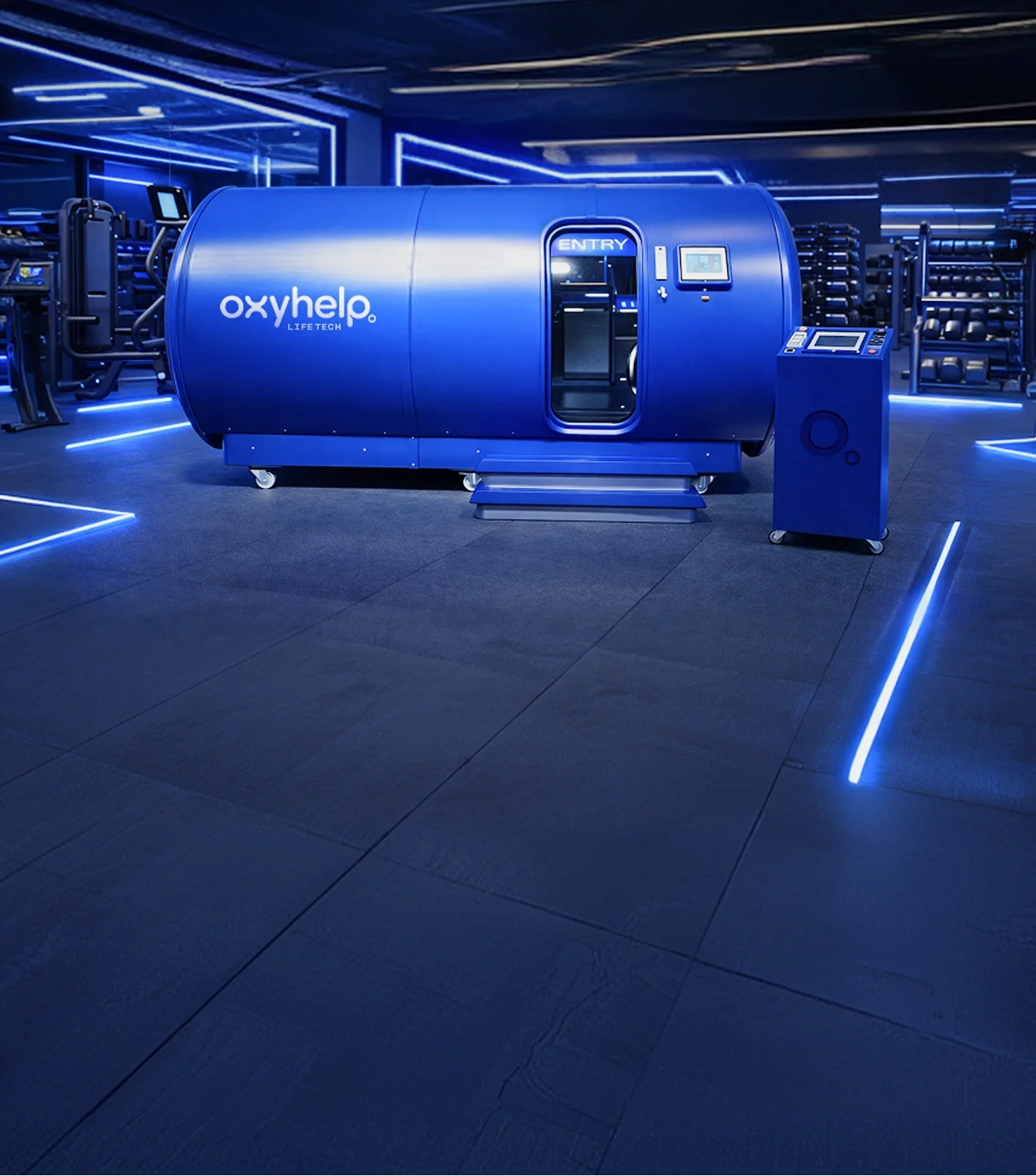
We chose a rowing machine over a bike or a treadmill because it works most of the body with low joint impact, fits the length of a C series cabin, and keeps the person seated and stable while the chamber is under pressure. The chairs come out, a rail-mounted rower goes in, and the two-way touchscreen stays within reach so the session can be paused or ended from inside at any moment.
A typical training session runs at 1.3 to 1.5 ATA, the same mild range as a resting session. Pressurisation takes a few minutes, the work block runs twenty to thirty minutes at a steady effort, and depressurisation is gradual rather than fast. The chamber is not a place for maximal intervals; the research effect is about sustaining effort, not about peak output, and the cabin air load argues for the same thing.
Two practical notes. Ear equalisation happens during pressurisation, before the effort starts, so the session begins with the person still. And the mask stays on throughout; the benefit measured in the studies came from oxygen delivered to the breath, not from oxygen in the room.
The short version
Exercising inside a mild hyperbaric chamber has a real, measured effect: muscle holds power longer before fatigue sets in, and recovery after hard training is reported as easier. The effect is modest and it does not persist once the session ends. It does not change resting metabolism, it does not replace training, and it makes no medical claims. What it does demand is a chamber whose ventilation and cooling were designed for a person working, not resting. That is the difference between a chamber you can train in and one you should only lie down in, and it is the reason the OxyLife Gym configuration exists.