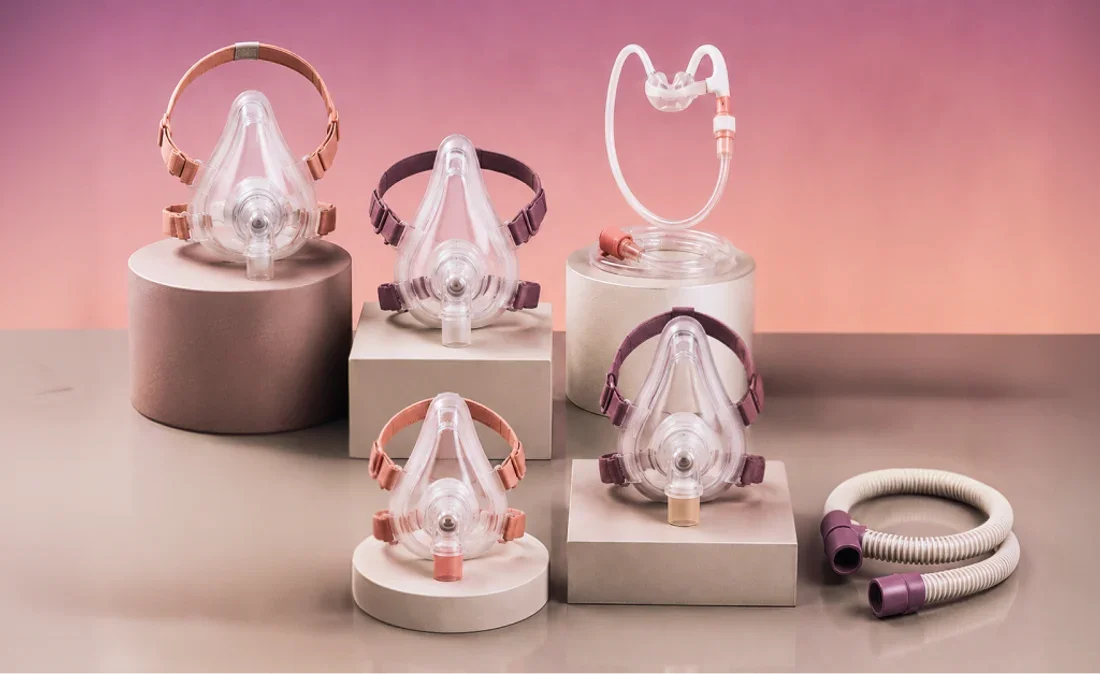
BIBS stands for built-in breathing system: the mask circuit inside a hyperbaric chamber that brings a chosen gas to the person and takes their exhaled breath away. In clinical chambers it is a regulated piece of equipment. In the wellness market the name, or the idea behind it, gets attached to something much simpler: a mask on a hose, plugged into an oxygen concentrator, inside a sealed cabin. That is a pseudo BIBS. It looks like the real thing in a brochure photo and behaves nothing like it over a forty-minute session.
This article is about equipment, air and fire safety, not about health outcomes. It is written by a manufacturer, so it comes with a point of view; the physics does not.
What a real breathing system does
A breathing system has three jobs. First, the gas it delivers has to reach the airway undiluted, so what the concentrator makes is what the person breathes, not a mixture with whatever is floating in the cabin. Second, the exhale must not come back: every breath out carries carbon dioxide, and a mask without one-way valves or a flushing flow turns into a small bag you re-breathe from. Third, the exhale has to leave the cabin. In a clinical chamber it is dumped overboard through a dedicated line; in a wellness chamber the equivalent is continuous ventilation, fresh air pushed in and stale air pushed out for the whole session.
Miss any one of the three and you have a pseudo BIBS. The mask is still there, the hose is still there, and the concentrator hums along. What is missing is invisible until you measure the air.
Where the pseudo version fails
The most common setup is a concentrator feeding a sealed inflatable chamber. The oxygen is not delivered to a mask at all; it is bled into the bag and mixes with the cabin air, settling somewhere around 24 percent. The person breathes the room. Nothing reaches the airway undiluted, so the first job fails on day one.
The second failure is the mask itself. A plain mask with no valves holds a pocket of your last exhale, and the next breath starts from that pocket. This is called dead space, and it is why some people feel worse in a mask than without one. A non-rebreather mask solves it with one-way valves and a flushing flow that clears the exhale before the next breath; a nasal cannula or nasal pillows avoid the pocket entirely.
The third failure is the one that decides how a session feels. In a sealed cabin the exhale has nowhere to go. Carbon dioxide, humidity and heat gather around the person, breath by breath. By the second half of the session the air is warm, damp and heavier in CO2 than any room you would choose to sit in. That stuffy, heavy feeling is not the pressure. It is the pseudo BIBS doing exactly what a mask on a hose does in a closed box.
The part about fire
Oxygen bled into a sealed cabin does not stay at 24 percent forever; it climbs with every minute the concentrator runs, and the fabric, the foam and the electronics inside are now sitting in enriched air. Safety codes for hyperbaric facilities cap the oxygen in chamber air at 23.5 percent for exactly this reason. The chamber fires reported in the press happened in cabins filled with pressurised oxygen, where a spark or a device brought inside is catastrophic. A pseudo BIBS in a sealed bag drifts in that direction slowly, and nobody is measuring.
OxyLife cabins are pressurised with ordinary air. Oxygen arrives only at the mask, from a concentrator, through feeding nozzles built into the cabin wall, and the ventilation that clears your CO2 also clears the small amount of oxygen that escapes around the mask. The cabin air stays air. That is why a phone or a tablet inside is not the hazard it would be in an oxygen-filled clinical chamber.
What OxyHelp does instead
Three interfaces, one rule that never bends: you do not re-breathe your own CO2. A nasal cannula for comfort and long sessions, nasal pillows that seal into the nostrils so the concentrator output reaches the airway undiluted, and a non-rebreather mask with one-way valves and a flushing flow for people who breathe through the mouth. Any of them connects to the standard nozzles inside the cabin, so a mask you find comfortable locally works too.
The exhale leaves the way it should. Fresh air is pushed through the cabin from the first minute to the last, at a flow calculated from the number of people inside, and stale air is pushed out. Minute forty feels like minute one. That is the third job of a breathing system, done by the chamber rather than by a hose, and it is the reason two chambers with the same mask can feel nothing alike.
Questions to ask before you buy
Where does the oxygen go: to the mask, or into the cabin? Does the mask have one-way valves or a flushing flow, or is it a plain cup? Where does my exhale go, and what is the CO2 in the cabin at minute forty? What is the oxygen percentage of the cabin air at the end of a session, and how was it measured? A seller with a real breathing system answers all four with numbers. A seller with a pseudo BIBS changes the subject to the percentage printed on the concentrator.
The short version
A built-in breathing system delivers gas to the airway, keeps the exhale from coming back, and removes it from the cabin. A mask on a hose in a sealed chamber does the first badly and the other two not at all. It is not dangerous in the way a pure-oxygen chamber is, but it is stale, it drifts toward enriched air, and it is the reason a session can feel like nothing. Buy on where the oxygen goes and where the exhale goes, not on the photo of the mask.